
There is a moment every vinyl collector knows: you slide a glossy sleeve off the turntable, breathe in that warm vinyl scent, set the record down and it refuses to sit flat. Your heart sinks. Did the postman drop it, did the heat in the car do this, or is it a defect from the pressing plant?
I remember when a 1972 pressing of Miles Davis I picked up at a Paris flea market arrived with a faint cup in the center. At first it sounded fine, then on loud trumpet notes the stylus skipped vertically like a small boat on choppy water. Crate-digging teaches you to spot these things fast. Over the years, between running my fingers along 2,000 plus jackets and talking to pressing plant techs in Brooklyn and Paris, I learned a set of practical, non-destructive tests that separate a true warp from a turntable problem or simple surface grime.
What a warp actually is
Call it a warp when a record departs from a flat plane. Simple as that. There are degrees. Mild warps are mostly cosmetic, a slight ripple you notice when you hold the disc to the light. Moderate warps change playback: pitch flutter, subtle vertical stylus movement, mistracking on energetic passages. Severe warps prevent the stylus from tracking at all.
Two common shapes matter because they behave differently. Edge-rise is when the rim tilts up or down relative to the label. Cupping refers to a dome around the label area, the center bowed either toward or away from the platter. Both change the stylus geometry, and both can create wow and flutter, which are slow and rapid pitch variations caused by vertical groove motion.
Visual inspection: the first, easiest test
Start with your eyes and hands. This is how I spot most mild problems during a quick shop check.
- Hold the record at a low angle to a bright, even light. Look for wavy reflections across the playing surface. A flat record gives a steady reflection; ripples reveal a warp.
- Look at the rim profile. Rotate the record slowly and watch the edge for dips or waves. Edge-rise shows as a consistent tilt or wobble at the perimeter, whereas cupping looks like a change in the central label plane.
- Check the spindle hole. If the hole is punched off-center it can mimic warp-like wobble when spinning. Wiggle it gently to feel looseness.
These are non-invasive and reveal most mild to moderate warps before you ever touch your turntable.
Flat-surface test: glass and granite
If the visual check raises questions, move to a known-flat surface. Use a clean sheet of glass or a granite tile. These are more reliably flat than many turntable platters.
- Lay the record on the glass with the label facing up. If you see gaps or uneven contact beneath the rim, that is a warp. Small air pockets under the edge are a dead giveaway.
- Do the same with the playing side up. A central dome will show as a visible air gap around the label area.
- Do not press the record flat. You are only checking, not trying to force it back into shape.
This test is the most objective backyard equivalent of the pressing plant inspection table.
Turntable tests: non-invasive listening and observation
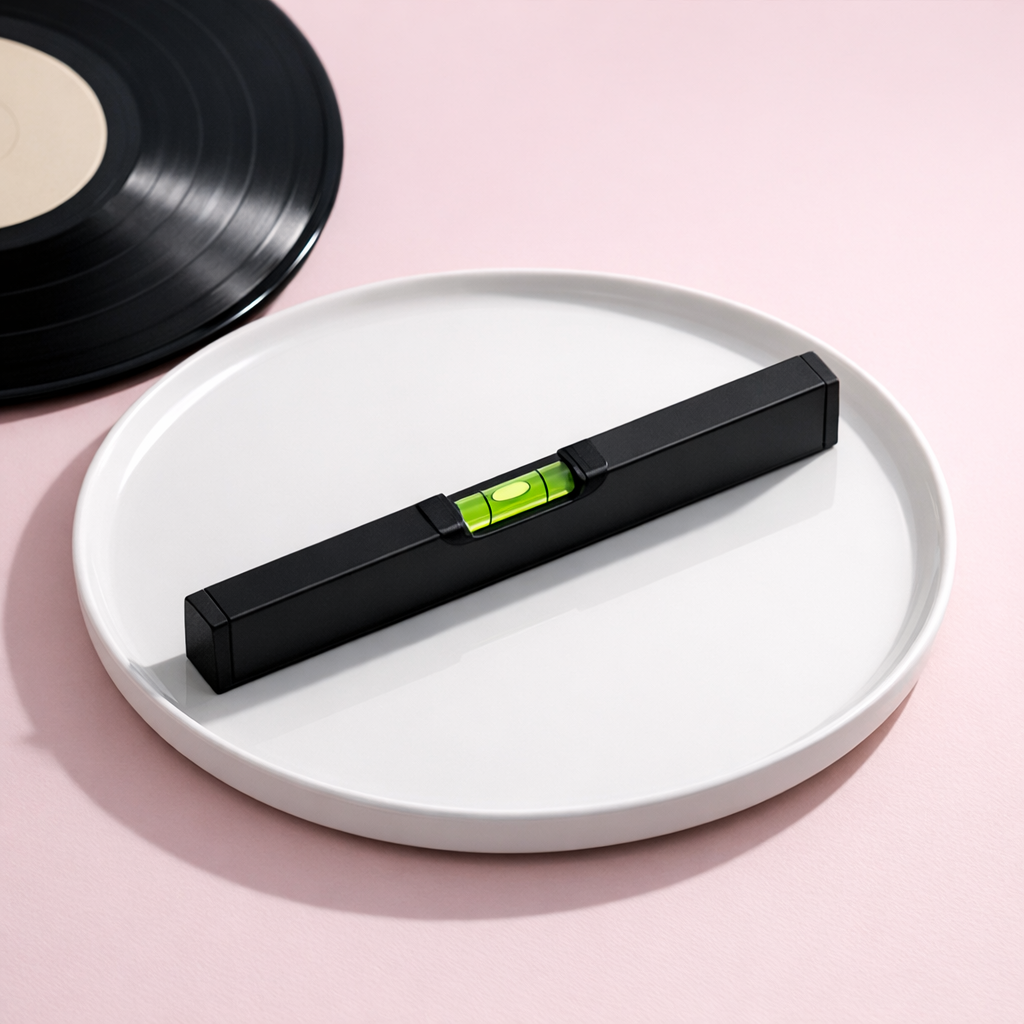
Fast forward to today, with your properly set up turntable. Before blaming the record, make sure the deck is honest. Use a spirit level on the platter to verify the turntable itself is level. Platter runout or a warped mat will create the same vertical motion you see attributed to a record.
Then run these checks in this order.
- Remove the mat and play the record on a flat platter and correct speed. Listen for pitch flutter on sustained notes. Standard speeds are 33 1/3 rpm for 12 inch LPs, 45 rpm for singles and some 12 inch singles, and 78 rpm for shellac discs. The faster the speed, the more noticeable vertical wobble can be.
- With the cartridge lifted, manually rotate the record and watch the vertical stylus movement or tonearm dip. Do not force the arm into the grooves. You are watching how the record moves the stylus up and down, which reveals warps in real time.
- Try a light-weight clamp or heavy mat only for comparison. These will press the disc flatter and may make a warp disappear during playback. That tells you the warp is mild and can be masked, but it does not mean the record is actually flat.
These tests show how the record behaves during real playback. I once played a 180 g reissue that looked perfect visually but on loud drum hits a small vertical jump caused the stylus to momentarily lose contact. Heavier 180 g pressings, typically 1.8 to 2.0 mm thick, are stiffer and resist small warps, but they are not invulnerable.
How to tell if the deck is to blame
Many collectors reach for the record when the problem is the turntable. Think about it this way: a warped platter or misaligned tonearm will create exactly the symptoms you are attributing to the disc.
- Use a spirit level on the platter. If the platter is not level, adjust the feet or the shelf. Leveling fixes a surprising number of complaints.
- Swap mats. A squishy mat can mask platter irregularities and vice versa. Remove the mat and run the visual and listening tests again.
- Check platter runout with a disc you know is flat, or use a precision straightedge over a sheet of glass. If multiple discs show the same wobble, the turntable is suspect.
- Verify the cartridge alignment and tracking force. Heavy-tracking cartridges amplify small warps into audible problems. Tracking force and SRA (stylus rake angle) affect how the stylus handles vertical excursions.
If the deck checks out and the record fails the glass test and the tonearm-drop observation, you have a warped disc, not a bad turntable.
Common mistakes people make when diagnosing warps
I hear these every time I teach a crate-digging class or answer reader mail. Avoid them.
- Blaming warps when the platter, mat, or turntable setup is the cause. Check the deck first with a known-flat reference disc.
- Flattening with a heavy clamp or thick mat during testing. That hides the warp rather than diagnosing it. You want to observe the warp unmasked.
- Relying only on casual listening. Low-level warps might only show up on loud passages or with heavy-tracking cartridges but still contribute to increased groove wear over time.
- Using heat or household pressure to test flattening. Heat and DIY pressing alter the vinyl and risk permanent groove damage. Never use oven, hair dryer, or random weights for prolonged periods.
- Misreading surface dirt, label lifting, or spindle hole wobble as a warped disc. Clean the surface and inspect the hole before assuming structural deformation.
When a warp matters and what to do about it
Not every warp needs heroic action. Small cosmetic ripples that do not affect playback can live in a sleeve and remain collectible. But if you hear pitch instability, vertical stylus jumps, or consistent mistracking, act.
Options:
- Swap or refund. If you bought it new or from a seller with a return policy, ask for a replacement. For custom vinyl from a reputable maker like Vinylacy, contact customer support. Custom pressings made in France and finished to premium standards often have stricter QC, and replacements are feasible.
- Use a clamp or heavy mat only during listening sessions. This masks the warp and lets you enjoy the music without forcing the vinyl back into shape. Remember this hides the issue rather than fixing it.
- Professional flattening. There are specialist services that use controlled heat, vacuum, and precise pressing to restore flatness. This is not cheap but keeps the grooves intact when done right. Ask for references and credentials. DIY heat methods are risky and common causes of ruined copies.
- Accept and archive. For rare or valuable records where restoration risks more damage than it’s worth, store them flat in a cool, climate controlled place and use a playable copy for listening.
One case study: a small indie label shipped a run of test pressings that arrived with a subtle cupping. Most collectors played them without issue, but one audiophile with a high mass tonearm reported consistent vertical jumps. The label offered replacements and contracted a pressing plant to review cold-press cooling times. The fix was procedural, not necessarily the vinyl formula.
Glossary
- Warp: any deviation from flatness of the record surface.
- Cupping: central dome-like deformation around the label area.
- Platter: the rotating surface of the turntable that supports the record.
- Wow & flutter: slow and rapid pitch variations caused by speed or vertical groove motion.
- Stylus tracking: the cartridge needle following the groove; vertical movement reveals warps.
Testing for warps is part craft and part detective work. Use your eyes first, validate on a known-flat surface, then confirm with careful listening and tonearm observation. And always rule the turntable out before declaring a record ruined.
Vinyl is tactile and imperfect by design. Custom pressing houses like Vinylacy aim to minimize these imperfections through careful QC and premium materials, whether you choose NOIR, CRYSTAL, or HAZE variants. For gift-givers and artists commissioning custom records, a quick flat-surface check when your order arrives will catch issues before you hand the record to someone else.
There is an intimacy to this maintenance ritual. You place the record on the platter, level the deck, lower the arm and listen as the needle hugs the groove. Warps are part of analog life, but with a few simple tests and a clear sense of when to repair, replace, or live with them, you keep the music spinning true, with that warm crackle intact.